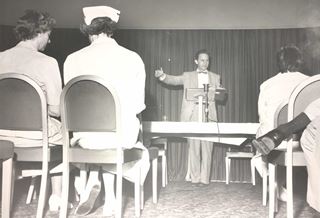
Meet Our Founder
“You set up an experiment to test the theory, and most of the time it’s not the way you thought it would be. But that’s the way you learn. You go from hypothesis to hypothesis. And it’s exciting because that’s the way we learn to treat, to diagnose, and to prevent illness.” [ Learn More › ]
Our History
| External Scientific Milestones Relevant to Coriell | Coriell Institute Record of Accomplishments and Milestones | ||
|---|---|---|---|
| 1939 | Lewis L. Coriell publishes a paper on an aspect of science he would revolutionize: His pioneering techniques for characterizing, freezing, and storing non-contaminated cell cultures in liquid nitrogen constitute one of the greatest contributions to modern human genetics. | ||
| Growth of virus in cell culture by Enders, et al. | 1949 | 1951 | Dr. Coriell, whose history in polio research began during his residency at Children’s Hospital of Philadelphia, is appointed field director for the Polio Prevention Study. The success of the study began the nationwide efforts to essentially eradicate polio. |
| Development of HeLa cell line by Gey, et al. | 1952 | 1953 | Dr. Coriell works with Camden City business and civic leaders to charter the South Jersey Medical Research Foundation. |
| Francis H. Crick and James D. Watson describe the double helix structure of DNA. Deoxyribonucleic acid (DNA) contains the genetic instructions used in the development and functioning of all known living organisms. The DNA segments that carry this genetic information are called genes, but other DNA sequences have structural purposes, or are involved in regulating the use of this genetic information. Within cells, DNA is organized into long structures called chromosomes. | 1953 | 1956 | June: the South Jersey Medical Research Foundation is officially dedicated. |
| Joe Hin Tjio and Albert Levan co-author the paper that defines 46 as the exact number of chromosomes in human somatic cells. | 1955 | 1957 | Dr. Coriell and his team find that blood of a cow inoculated with HeLA cells developed antobodies to cancer cells. |
| Vernon Ingram, often described as the “father of molecular medicine” identifies the single base difference between normal and sickle-cell hemoglobin. That the mutation of a single letter in the DNA genetic code is sufficient to cause a hereditary medical disorder is far reaching. | 1956 | 1957 | NIH awards first grant to the Institute for cancer research. |
| 1957 | The Fourth International Poliomyelitis Congress awards Dr. Coriell its Presidential Award. | ||
| 1958 | Recognition of importance of mycoplasma by Coriell. | ||
| 1959 | Dr. Coriell calls for the establishment of a central tissue culture bank and cell registry to certify and store cell cultures. The Institute is selected as one of two of the nation’s recognized cell banks. | ||
| 1959 | Warren W. Nichols, Ph.D., joins the Institute. During his 25-year affiliation with the Institute he would gain an international reputation in the field of cytogenetics – the science of chromosomes and cell division. He was honored with the Coriell Medal in 2002. | ||
| 1960 | Public Health Service pledges nearly $100,000 research facilities grant toward construction of new building to house cell bank operation. | ||
| 1961 | Dr. Nichols and Dr. Albert Levan perfect methods for visualizing chromosomes. They discover that viruses, such as measles, can induce genetic changes. | ||
| Leonard Hayflick, PhD, discovers that cultured human normal human and animal cells have a limited capacity for replication; is known as the Hayflick Limit. | 1962 | 1962 | Coriell’s Dr. Dutcher analyzes a variety of tissue cultures of leukemic tumors from leukemic cows and identifies over two dozen viruses. Dutcher announces pathological and clinical aspects of the diseased herd were exhibiting many similarities to human leukemia. |
| 1963 | Dr. Coriell recieves Delaware Valley Council’s “Man of the Year” award. | ||
| 1964 | NIH partners with the Institute to create the first standardized cell respository; it is funded by the National Cancer Institute. | ||
| Discovery of pluripotency of embryonic stem cells by Kleinsmith and Pierce. | 1964 | 1964 | January 14th: Official inauguration of what would become the world’s largest and most diverse repository of human cells. |
| 1964 | Cell Bank Research Laboratory and department of Cytological Biophysics is founded. | ||
| 1964 | Major building expansion program gets underway. | ||
| President Kennedy designates the year as Cancer Progress Year. | 1965 | 1965 | Drs. Coriell and McGarrity apply infection control technology, specifically laminar flow, to research and clinical use. They perfect the laminar flow hood which are as common on modern laboratories as a microwave in a kitchen. |
| American biochemist Marshall Nirenberg, and others, decipher the genetic code that allows nucleic acids with the 4 letter alphabet. | 1966 | 1966 | By this year, four distinct departments – biochemistry, cell biology, cytological biophysics, and cytogenetics – are led, respectively, by leaders in their field: Jesse Charney, Arthur Greene, Daniel Moore, and Warren Nichols. |
| DNA is found to be present not only in chromosomes, but also in mitochondria. | 1966 | 1966 | Renamed Institute for Medical Research. |
| 1966 | Daniel Moore proves that a virus causes mammary tumors in highly inbred strain of mice. | ||
| 1967 | Institute has characterized, standardized, preserved, and placed into the national cell bank, a total of 35 pure cell lines. | ||
| 1969 | Dr. Coriell joins Cooper Hospital’s board of managers. | ||
| 1971 | Moore annouces results in article “Search for Human Breast Cancer Virus” in prestigious British journal, Nature. | ||
| 1972 | NIGMS Human Genetic Cell Repository is established at the Institute. | ||
| American biochemist Paul Berg develops technique to splice DNA fragments from different organisms, creating the first “recombinant” DNA. He was awarded the Nobel Prize in chemistry in 1980. | 1972 | 1972 | NIGMS establishes Human Genetic Mutant Cell Repository at the Institute. As interest in genetic disease expands, NIH recognizes the Institute’s reputation in excellence in cell biology and selects the Institute over 17 others competing for the award. |
| 1974 | Sponsored by the National Insitute on Aging, the national Aging Cell Repository is established at the Institute. | ||
| Eli Lilly markets the first genetically engineered drug – a type of human insulin grown in genetically modified bacteria. | 1982 | 1978 | Institute celebrates 25 years in research. |
| The first artificial chromosome is created and the marker – the usually dominant gene or trait that serves to identify genes or traits linked with it – for Huntingdon’s Disease was identified. | 1983 | 1979 | Coriell’s cell biology department supports Huntingdon’s Disease research of Dr. Nancy Wexler and James Gusella (MGH) by collecting Dr. Wexler’s skin biopsies and blood samples; they are grown, harvested, catalogued, and stored until used by MGH to isolate and identify a genetic marker of HD. |
| Invention of the polymerase chain reaction (PCR), which amplifies (or produces many copies of) DNA; this technology enables geneticists and medical researchers to analyze and manipulate DNA from the smallest samples. | 1985 | 1985 | Dr. Coriell retires his role as president of the Institute. It is renamed the Coriell Institute for Medical Research. |
| 1988 | Institute biochemist, Richard Mulivor, Ph.D., develops a prenatal test for hypophosphatasia, a severe metabolic disorder always fatal in infancy. | ||
| “Genetics” refers to the study of a single gene at a time, while “genomics” is the study of all genetic information contained in a cell. The Human Genome project is launched with the primary goal of determining the sequence of chemical base pairs which make up DNA and identify and map the approximately 20,000 to 25,000 genes of the human genome. | 1990 | 1990 | NIMH repository for the study of psychiatric diseases. |
| 1990 | Juvenile Diabetes Research Foundation cell collection established. | ||
| 1992 | American Diabetes Association Maturity Onset (Type II) collection established. | ||
| 1995 | Stem Cell Biology program established. | ||
| 1995 | National Cancer Institute (NCI) Breast Cancer collection established. | ||
| 1996 | Coriell is licensed as the first umbilical cord blood bank in the state of New Jersey. | ||
| 1998 | National Eye Institute collection for macular degeneration study established. | ||
| 1998 | Autism Research Resource established at Coriell. | ||
| 1998 | The Institute embarks on stem cell biology research. | ||
| 1999 | Coriell opens its new laboratory building in Camden, NJ. | ||
| 2000 | New Jersey Cord Blood Bank established at Coriell. | ||
| 2001 | National Science Foundation non-human primate repository established. | ||
| The genetic variation mapping project, HapMap is launched. It aims to develop a haplotype map of the human genome which will describe the common patterns of human genetic variation expected to be a key resource for researchers to find genetic variants affecting health, disease, and responses to drugs and environmental factors. The information will be made freely available to researchers around the world. | 2002 | 2002 | NINDS Human Genetics Resource Center DNA and Cell Line repository established at Coriell. |
| 2002 | Adipose and pancreatic stem cell biology program established. | ||
| 2002 | National Institute of Neurological Disorders and Stroke (NINDS) repository for stroke, epilepsy, and Parkinson’s disease established. | ||
| Completion of the Human Genome Project. | 2003 | 2003 | Coriell celebrates 50 years of science in Camden, NJ. |
| 2006 | NHGRI Sample Repository for Human Genetic Cells Repository established to support the HapMap Program; currently supports the International 1000 Genome Project. | ||
| Shinya Yamanaka, Kyoto University and James Thompson, U of Wisconsin, separately create first human induced pluripotent stem cells (iPSCs). | 2007 | 2007 | Michael Christman, Ph.D., an expert in genetics and genomics, joins the Coriell Institute as president and CEO. |
| 2007 | Coriell Personalized Medicine Collaborative is launched. | ||
| 2007 | Coriell establishes multi-million Genotyping and Microarray Center. | ||
| 2008 | Coriell retains NINDS repository after nationwide competition. | ||
| 2010 | Coriell becomes the first New Jersey laboratory CLIA-certified to perform GeneChip-based genetic tests. | ||
| 2011 | CPMC issues first pharmacogenomics report. | ||
| 2011 | Momentous alliance between Coriell and Air Force launched; target to enroll 2,000 active-duty medical service personnel in the CPMC research study. | ||
| Nobel Prize in Physiology/Medicine awarded to Dr. Yamanaka and Sir John Gurdon for their discovery of iPS cells. | 2012 | ||
| 2013 | Coriell commemorates 60 years of scientific research. | ||
| 2013 | Coriell and IBM partner to form for-profit, genetic storage and interpretation company: Coriell Life Sciences. |
Giving to Coriell
Meet our Team
Click here to meet our experts.
Coriell scientists are available to speak with you on a variety of topics. Please contact Coriell Communications.